Outside of the transformation going on at the Angel Mounds interpretive center, another restoration has been happening quietly in the northwest corner of the historic site.
But it won’t stay quiet for much longer.
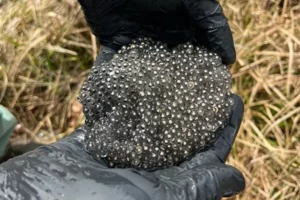
Nearly 40 years after they vanished from the site, a colony of state-endangered crawfish frogs, a large amphibian species with a distinctive croak, was successfully reintroduced at Angel Mounds this spring.
The project began in 2022 when Southwest Regional Director Mike Linderman started working with the Indiana Department of Natural Resources to complete a broader study of wildlife at the site. DNR Division of Fish and Wildlife Herpetologist Nate Engbrecht conducted a habitat suitability analysis and determined Angel Mounds has the ideal environmental conditions to support crawfish frogs. In particular, Engbrecht keyed in on four small ponds west of the village site that fill with water after each winter but dry out during the summer.
 The ponds formed centuries ago from “borrow pits,” or large holes left after Native Americans built the mud wall at Angel Mounds. Those same ponds supported breeding for a large population of crawfish frogs that thrived from the time the village was inhabited until 1985, when the frogs suddenly disappeared following a long summer drought.
Crawfish frogs are secretive, prairie-dwelling amphibians that spend much of their lives underground. The adult frogs, which can grow to the size of a softball, rely on habitat created by burrowing crayfish, thus lending to their name. After sheltering in those burrows through the extreme weather months, the frogs emerge each spring and travel to nearby ponds to breed, leading to a chorus of croaking that you can hear up to 2 miles away.
Land development has greatly reduced the species’ traditionally wide range across southwest Indiana down to just a few pockets, mostly in Greene County and none in Evansville.
“Indiana only has a couple of good populations of crawfish frogs left,” Engbrecht said. “This project is part of historic preservation. It’s part of what we’ve inherited that’s just barely hanging on. At this point, it’s like a restoration project.”
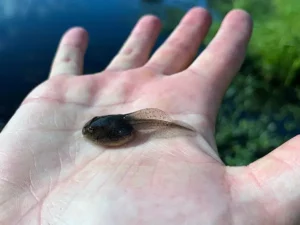
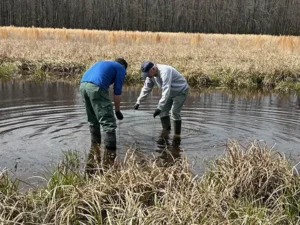
In March, Engbrecht and retired naturalist/herpetologist Mike Lodato collected several crawfish frog egg masses from another site and relocated them to Angel Mounds. Within weeks, hundreds of tadpoles filled the ponds and began their metamorphosis.
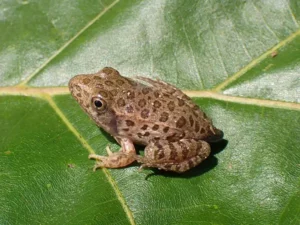
Finally, following decades of absence, dozens of small, spotted frogs started emerging from the water by early July. As happy as Linderman was to see the frogs for the first time, he said it will be even better to hear the frogs croaking again when mating season begins in the spring.
“We are a multi-faceted site,” he said. “It’s about culture, history and the natural and environmental components that we tap into, like this. We’re helping an endangered species return to its natural habitat where it once thrived, that’s pretty exciting.”

-
Visit Museum
PLAN YOUR VISIT to the MUSEUMINDIANA STATE MUSEUM HOURSOpen Wednesday - Sunday10 am – 5 pmCONTACT US650 W. Washington St.
Indianapolis, IN 46204 -
Historic Sites
EXPLORE our HISTORIC SITESINDIANA STATE MUSEUM HOURSOpen Wednesday - Sunday10 am – 5 pmCONTACT US650 W. Washington St.
Indianapolis, IN 46204 -
Things To Do
THINGS to DOINDIANA STATE MUSEUM HOURSOpen Wednesday - Sunday10 am – 5 pmCONTACT US650 W. Washington St.
Indianapolis, IN 46204 -
Educators
GROW YOUR MIND at the MUSEUMEDUCATION AT our HISTORIC SITES
- Collections
-
Donate
INDIANA STATE MUSEUM HOURSOpen Wednesday - Sunday10 am – 5 pmCONTACT US650 W. Washington St.
Indianapolis, IN 46204 - Buy Tickets
- Membership